
Why Stride Survives Backlash
The real reason virtual-school controversy rarely results in removal

Conventional wisdom about Stride (previously known as K12 Inc) says it is controversial, politicized, and always one legislative session away from collapse.
Take the recent disclosure of a complaint filed by the Gallup-McKinley County Schools Board of Education, and additional disclosures in October’s earnings call of “poor customer experience.” On the expectation of a muted growth outlook, the stock (NYSE:LRN) fell 12% in September and a further 54% in October.
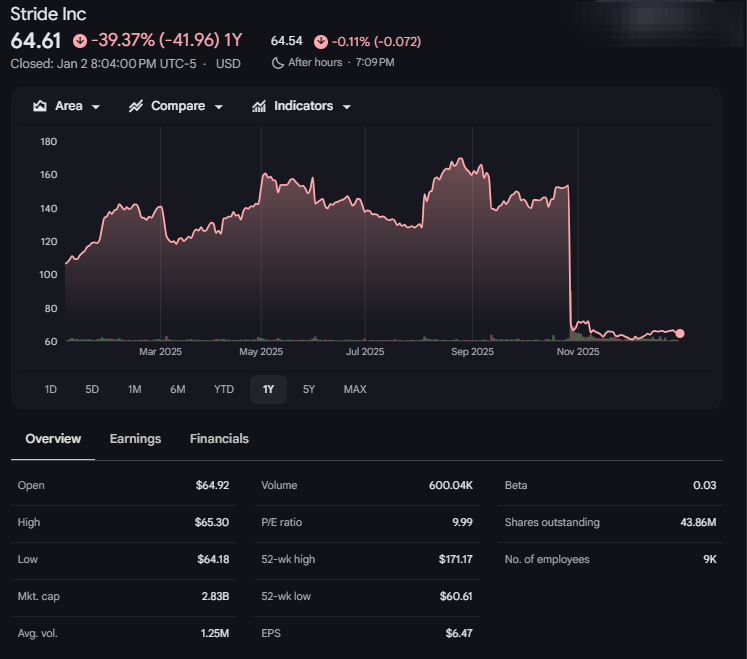
This story has been repeated for more than a decade: “Virtual schools are inferior.” “Outcomes are weak.” Teachers’ unions oppose them. Legislators posture against them. District leaders criticize them publicly. Headlines announce investigations, audits, and terminations. If you stop there, Stride looks fragile.
And yet, after all these years, Stride is still here, larger, more complex, and more embedded in state education systems than it was when those criticisms first emerged.
This gap between narrative and reality persists because most observers are evaluating Stride using the wrong unit of analysis.
The public narrative treats Stride like an edtech company whose fate should rise or fall with innovation cycles, academic outcomes, or political goodwill. In that frame, controversy equals weakness. Poor test scores equal existential risk. Contract terminations equal revenue loss.
But behavior revealed from our analysis of contract terminations, litigation records, board minutes, state performance audits, and earnings disclosures spanning more than a decade tells a different story:
When states, districts, or boards actually move against Stride, the outcomes rarely match the rhetoric. Termination headlines do not reliably translate into student loss. Investigations do not reliably translate into market exit. Legislative pressure does not reliably translate into unwinding.
What we see instead, across years and across states, is a pattern of accommodation, migration, and continuation.
Districts that loudly criticize virtual schools continue to authorize them. Legislators who condemn operators still preserve funding pathways. Boards that posture about accountability quietly accept operational dependence. Even when relationships rupture, the system bends before it breaks.
This is because the cost of disentanglement is higher than the cost of tolerance.
This analysis and the accompanying Intelligence Brief for our Premium subscribers is informed by public filings, earnings calls, state oversight reports, court records, investigative education journalism, and a review of interviews with operators, vendors, and district leaders who have lived through attempted exits. Our conclusions are driven by a remarkable level of consistency across sources and case studies.
There is a reason districts criticize Stride publicly while expanding outsourcing privately. The mechanics behind that contradiction, including where replacement attempts fail and where Stride is actually fragile, are unpacked in the full intelligence brief for Premium subscribers.
👉🏼 Join the early access list for the full Stride intelligence brief
Academic performance, while constantly cited in public discourse, is rarely the proximate trigger for decisive action. When pressure escalates into real disruption, it almost always flows through governance disputes, compliance failures, or operational breakdowns. Those are hard triggers. Test scores are usually narrative cover.
Most importantly, the actors inside the system behave as if replacing Stride is riskier than living with it.
School boards delay. Authorizers negotiate. States impose caps rather than closures. Even critics default to remediation over removal. The pattern repeats because the underlying structure rewards continuity and punishes rupture.
None of this means Stride is immune to failure. It means the commonly accepted explanation for why it should fail is incomplete.
The patterns we have identified in this analysis are not inferred from a single case. They show up repeatedly across states with different political climates and regulatory regimes, including documented transitions in Georgia, New Mexico, Indiana, Nevada, and Pennsylvania. In each instance, the same constraint appears: the operational cost of unwinding exceeds the political cost of tolerating controversy.
If you want to understand Stride’s position in K–12, you have to stop asking whether virtual schools are good or bad and start asking a different question: what actually happens when institutions try to unwind them?
The answer to that question is where the real story begins.

The Misdiagnosis
Most discussions about Stride, Inc. fail for a simple reason: they mistake visibility for causality.
Academic outcomes are visible. Political outrage is visible. Investigations are visible. These signals dominate the conversation because they are easy to observe and easy to argue about. They are also rarely the mechanisms that determine what happens next.
When Stride does lose ground, it is because something harder and less visible broke: governance alignment, compliance integrity, or operational continuity.
That distinction matters.
Academic underperformance tends to trigger remediation cycles, negotiated improvement plans, and public scolding.
Governance failure triggers termination clauses.
Compliance failure triggers audits and lawsuits.
Operational failure triggers immediate enrollment loss.
The system reacts very differently to each.
Again, behavior revealed through our research makes this clear. Districts tolerate years of mediocre outcomes. They do not tolerate data access failures, special education compliance gaps, or governance breakdowns that expose board members and superintendents to personal risk. When action comes fast, it almost always follows the latter.
This is why the common framing of Stride as a fragile edtech vendor misses the point. Edtech companies live and die by adoption curves and product differentiation. Stride does not. Its position is shaped by whether institutions can realistically disentangle themselves from the services it provides without triggering legal, operational, or regulatory failure.
In practice, most cannot.
Replacing Stride means a system transition. Student records, individualized education plans, staffing models, learning platforms, compliance workflows, and reporting systems are tightly coupled. Unwinding them requires coordination across legal, academic, and operational domains that few districts are equipped to manage under pressure.
Boards know this. Authorizers know this. Superintendents know this. Their behavior reflects it.
When pressure builds, the default response is rarely removal. It is containment. Enrollment caps. Oversight conditions. Renegotiated terms. Public distance paired with private dependence. These are signs of constrained choice.
This is the misdiagnosis at the heart of the Stride debate. Critics assume controversy should produce collapse. The system responds by absorbing the controversy and preserving continuity.
The result is a company that may appear perpetually embattled but remains structurally embedded, because it has positioned itself inside the operational spine of public education systems.
Understanding that gap between what is said and what is done is essential. Without it, Stride will continue to surprise observers who mistake noise for leverage and rhetoric for power.
And that misunderstanding has consequences for anyone competing, partnering, or planning around it.
The Implication Stride’s Competitors Miss
The mistake that Stride’s competitors make is assuming they are competing in the same game.
Most of them, are not.
These competing vendors approach districts as if decisions are driven by feature comparison, pilot success, or incremental improvement. They optimize for differentiation, usability, and outcomes. When they encounter resistance, they assume it is political or cultural.
Stride competes on something else entirely: control of instructional scope.
Once again, revealed behavior shows this clearly. Districts defend Stride because removing it forces them to confront risks they are structurally unprepared to absorb: Data continuity. Special education compliance. Staffing coverage. Reporting obligations. These are not abstract concerns. They are board-level liabilities.
This creates a quiet but powerful dynamic. Publicly, districts criticize virtual schools. Privately, they expand outsourcing. Public language signals distance. Private behavior signals dependence. Stride’s competitors who read only the rhetoric misunderstand where decisions are actually constrained.
The consequence is predictable. Other vendors compete for pilots while Stride consolidates the core. They sell tools while Stride embeds systems. They celebrate local wins while Stride operates across districts, authorizers, and states.
This is why Stride is rarely displaced by a different, better virtual product. It is displaced only when governance alignment collapses or when operational execution fails so visibly that the risk calculus flips. Those moments exist, but they are narrow and costly.
For Stride’s competitors, the lesson is uncomfortable but practical. If your offer lives at the edge of the instructional stack, you are not threatening Stride. If your success depends on a district cleanly unbundling services under scrutiny, you are betting against documented, repeated, revealed customer behavior.
Stride’s position is a case study in how systems behave under constraint. Vendors looking to displace Stride who ignore these lessons will continue to lose opportunities they thought were within reach.
The more useful question for Stride’s competitors is not whether Stride is right or wrong, good or bad. It is whether you are designing your GTM strategy for how institutions actually make decisions, instead of how you wish they did.
Understanding that distinction is where there are opportunities to create advantage.
This analysis explained why Stride continues to survive political backlash that should, on paper, be fatal.
We’ve prepared an intelligence brief that goes further.
It maps where control actually sits in the K-12 ecosystem, quantifies exit friction across real cases, and lays out which competitors are exposed, which are insulated, and which ones are mispositioned entirely.
If you are making capital, partnership, or competitive decisions in this space, you should read the full intelligence brief to sanity-check your current approach.
Let us know if you need the full Stride brief.
The Intelligence Council publishes executive-level intelligence for leaders building, selling, and competing in the K-12 education market. Our work focuses on revealed behavior, institutional incentives, and the gap between public narratives and how purchasing, renewal, and risk decisions are actually made. Readers include senior executives at curriculum, assessment, technology, and services vendors navigating complex district procurement, state policy, and governance environments.